
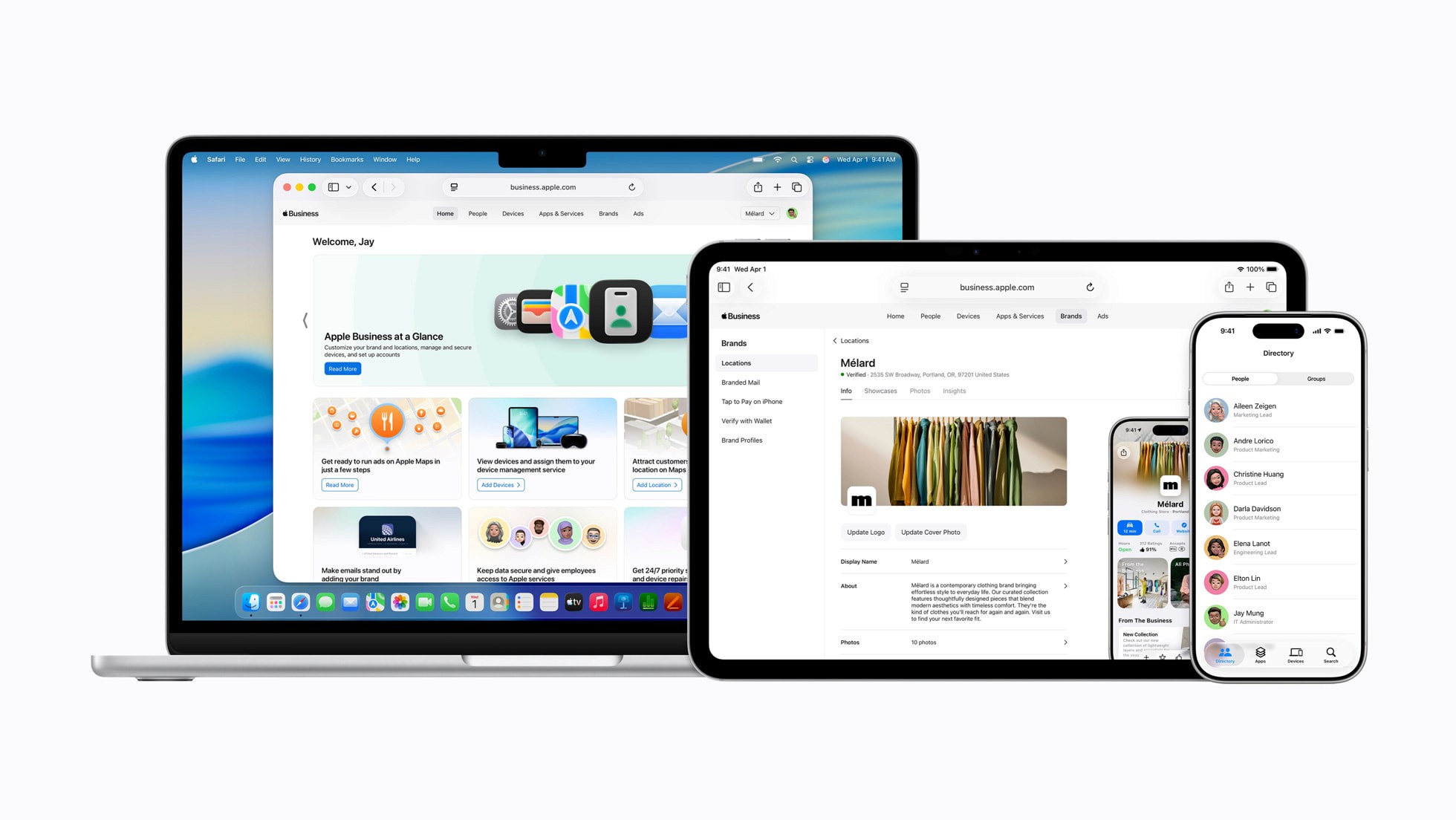
In a move that marks a milestone in technology management for companies, Apple announced the launch of Apple Business, a new platform that unifies key tools to operate, grow, and scale businesses into a single experience.
Available starting April 14 in more than 200 countries, this solution brings together what until now was fragmented into different products, with a clear goal: to simplify the way companies manage their technology and their daily operations.
And that, for many of the companies we work with at First Plug, is very good news.
A platform designed to eliminate friction
For years, managing devices, access, applications, and internal communication involved multiple tools, manual processes, and, in many cases, constant dependence on technical teams.
With Apple Business, that logic changes.
The new platform integrates into a single environment:
Built-in mobile device management (MDM)
User, access, and security setup
Application distribution for teams
Email, calendar, and business directory with its own domain
Tools to connect with customers within the Apple ecosystem
Everything is designed so that businesses can operate more simply, securely, and efficiently from day one.
From complexity to immediacy: What does it mean in practice?
One of the most relevant changes is in how the technology is implemented.
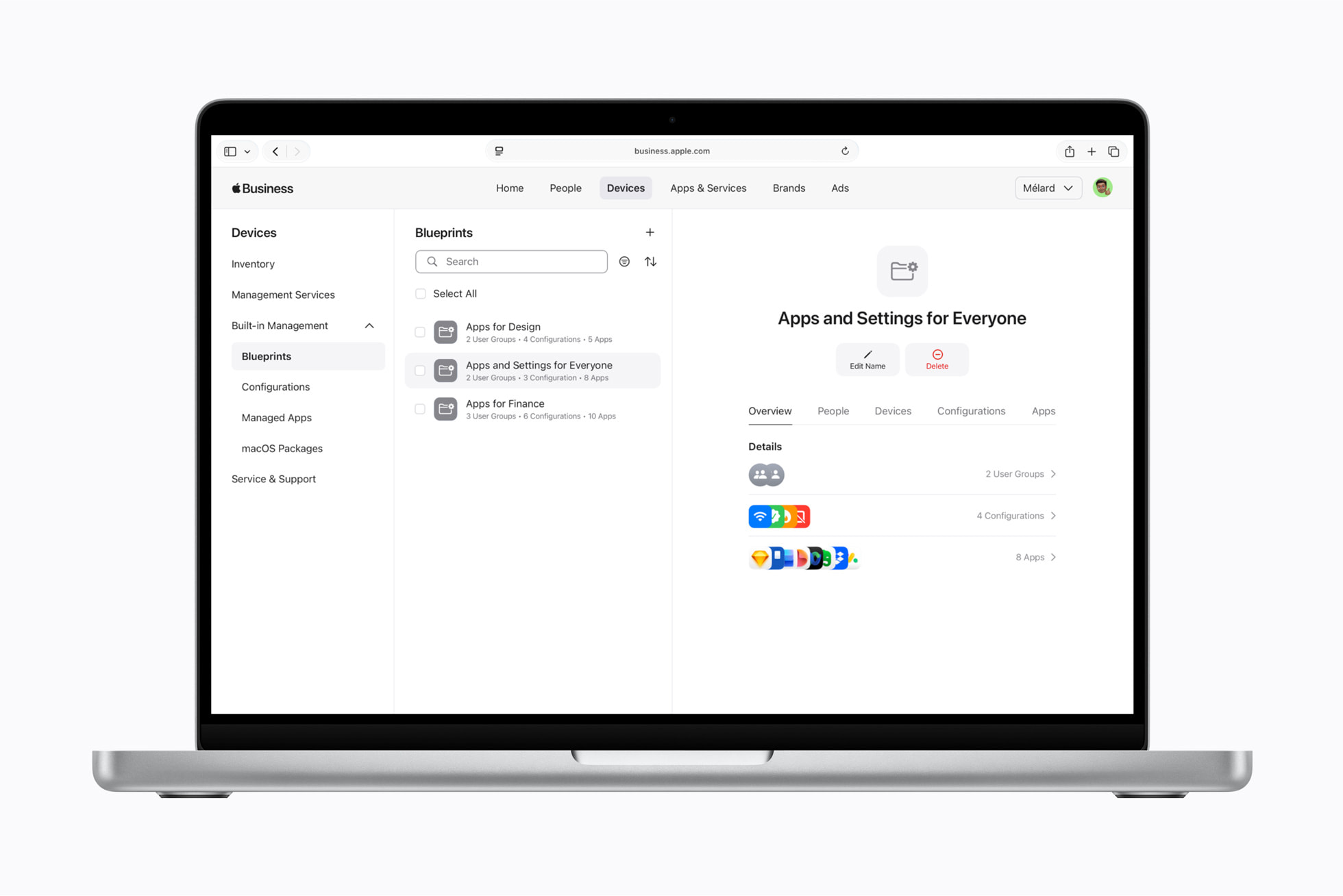
With features like "Blueprints", Apple allows the automated configuration of devices, teams, and permissions, reducing times and errors in processes that were previously manual.
In practice, this means that:
A new employee can have their device ready in minutes
The necessary apps are already installed from the start
Access is defined without constant intervention
That is, less operational friction and more focus on what matters: growing the business.

A real opportunity for SMBs and growing teams
Although the platform is available for companies of all sizes, its impact is especially strong on:
Startups
SMBs
Teams without an internal IT structure
Apple makes it clear: it aims to enable any company to access tools that previously required greater technical complexity.
This is a key point. Because in our experience working with startups, one of the main bottlenecks is not the lack of tools, but the difficulty of managing them.
Companies seek to focus on growth without wasting time and resources on infrastructure and systems. Our clients ask us for practical and easy solutions that allow them to scale.
More than management: also growth
Apple Business doesn't just target internal operations. It also incorporates new ways of visibility and connection with customers within its ecosystem: from Apple Maps to Mail, Wallet, or Siri.
The company even anticipates new features such as the ability to promote businesses on Apple Maps at key search moments.
This opens a new layer of opportunity for companies: not only to operate better, but also to be more visible.
How we are seeing it from First Plug
At First Plug, we work daily with companies that are at that growth stage where:
Operations are starting to become complex
Teams need structure
But they don't want to (nor can they) over-allocate resources
That's why these types of solutions fit directly with what we aim to implement: simple systems, clear processes, and tools that don't slow down the team. Apple Business goes in that direction.
It doesn't replace advanced solutions in all cases, but it does lower a major barrier to entry: making technology stop being a problem and start being an enabler.
A silent but profound shift
This launch is not just a product update. It is part of a broader trend: companies are no longer looking for more complex tools, but rather tools that disappear into the process. Tools that work, that do not require constant learning, and that support growth without friction.
Apple seems to have understood this. And for many companies, including our clients, that can make a real difference in how they operate, scale, and grow in the coming years.
You might also be interested in…