
Productivity and Operations

Productivity and Operations

7 min

What is Apple Business Manager and why should you implement it in your company?

What is Apple Business Manager and why should you implement it in your company?

Matias Lerner

An unenrolled Mac is like an office without a lock.


You hired someone new, gave them a brand-new Mac, and a month later that person left the company. The computer is still working, but now it is out of your control: no remote access, no monitoring, no possibility of recovering it. What happened? It was not enrolled in Apple Business Manager.


In this article, we tell you what it is, how it works, and why it can be key to your IT strategy.

What is Apple Business Manager? 


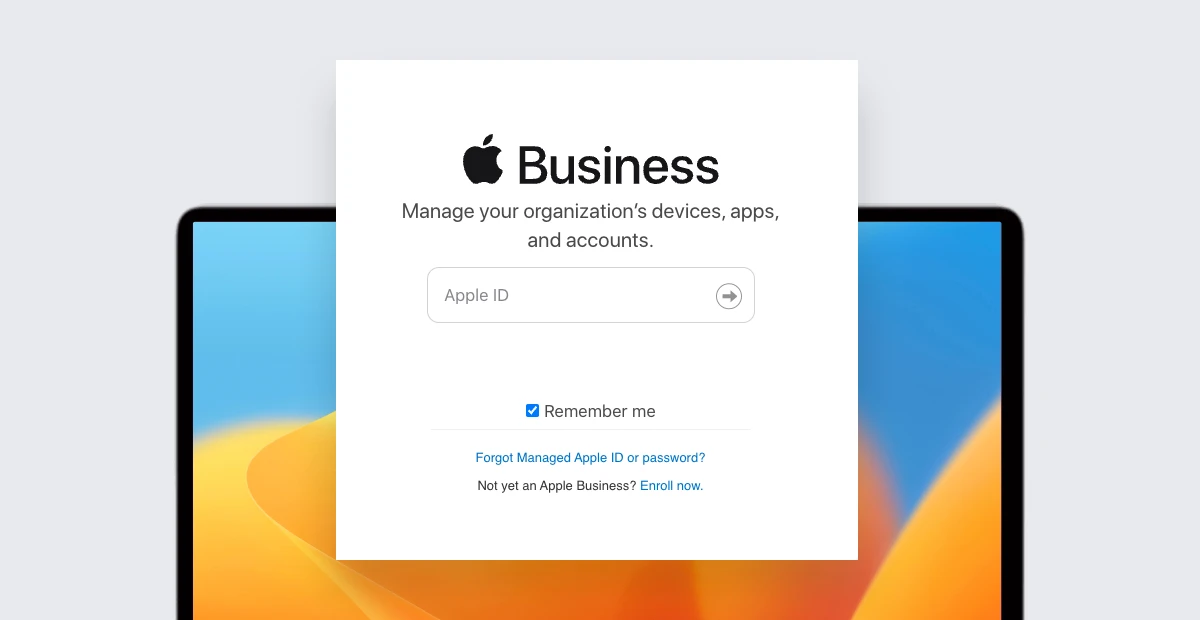
Apple Business Manager (ABM) is a web-based platform designed by Apple that allows you to manage all of your company's Apple devices from one place.


By integrating it with your MDM (Mobile Device Management) system, you can:

  • Automatically enroll any Apple device you purchase


  • Preconfigure access, apps, and permissions without touching the device


  • Assign devices to specific users or departments


  • Enforce remote monitoring and ensure traceability


  • Lock or wipe devices in case of loss or theft


Every Apple device you hand out goes 100% under your control.


The Relationship Between ABM and MDM


Apple Business Manager (ABM) and Mobile Device Management (MDM) are complementary tools that work together to streamline the management of Apple devices within organizations.


ABM acts as the foundation, allowing automatic device enrollment into the MDM system upon activation. This is achieved through Apple's MDM server or a third-party MDM server.


It also facilitates the bulk purchase of applications and content, which are then distributed to devices or users through the MDM solution.

Common mistakes we see (and how to avoid them)

  1. Not using Apple Business Manager


    Consequence: unenrolled equipment, without security, without traceability.

    Solution: register your company in ABM (it's free) and link it to your provider.


  2. Purchases through unofficial channels


    Consequence: they cannot be automatically enrolled in ABM.

    Solution: work with an official Apple Reseller that allows you to register the equipment in your ABM.


  3. Not integrating it with MDM


    Consequence: you have ABM but without real leverage.

    Solution: connect your ABM to solutions like Intune, Kandji, or Jamf to configure everything remotely.

Concrete benefits of using Apple Business Manager

  1. Time savings in configurations


  2. Reinforced security from the very first use


  3. Total traceability of each device


  4. Longer lifespan of devices


  5. Remote and error-free activation for new hires


In remote environments or those with high turnover, having control straight out of the box is essential.

How do we solve it at First Plug?


At First Plug, we are an Apple Reseller. That means every device you purchase from us can come already registered to your ABM, with no extra steps.


Additionally:

  • We help you register your company in Apple Business Manager


  • We advise you on integrating it with your MDM system


  • We configure the devices before shipping them


  • We guarantee traceability from day one


Your IT team shares the plan with us. We take care of everything.

In summary


Apple Business Manager is not just for large or technical companies. It is for any organization that wants to have full control over their Apple devices.


Because in today's world, an unenrolled device is an unnecessary risk. And with First Plug, it's a problem that is solved before you even start.

Manage your Apple devices securely


At First Plug we help you implement ABM and automate your entire operation.

Manage your Apple devices securely


At First Plug we help you implement ABM and automate your entire operation.

Written by

Matias Lerner

Matias Lerner

You might also be interested in…

First report with proprietary data from First Plug's operation. Period: January–June 2026.

Trends and Technology Strategy

Aug 7, 2026

5 min

Remote hardware management benchmark in LATAM: first half of 2026 data

First report with data from First Plug's own operation. Period: January–June 2026.


At First Plug, we accompany fast-growing remote companies that have their collaborators distributed throughout the region. Headquarters in one country, collaborators in others, someone new starting on Monday who lives 800 kilometers from the nearest capital.


This is the first report we are publishing with data from our own operation. It is not a survey or a market projection: these are actual orders processed between January and June 2026.  


We do this to tell you what hardware management looks like behind closed doors: how long it actually takes to reach someone's home in the interior of Colombia. Which part of the process generates the most friction. What changed in the market in six months. We have those answers because we operate them every day.


During the first half of 2026, we delivered 908 devices to 795 collaborators, across 21 countries, for 97 companies. 


The number that says the most of the four is the last one. Ninety-seven companies for nine hundred devices gives an average of 9.4 devices per company over the entire semester


Hardware management for remote teams is not a volume problem, but a dispersion problem. None of these companies buy in quantities that justify setting up their own logistics operation. But almost all of them need to put a computer in the hands of a person who lives in another country. On an exact date, with the software configured. And with someone to respond if something goes wrong.


Buying 500 devices for an office is a negotiation problem. Buying 9 devices for 9 people in 5 countries is a coordination problem. And coordination does not scale with budget, it scales with process.

First report with proprietary data from First Plug's operation. Period: January–June 2026.

Trends and Technology Strategy

Aug 7, 2026

5 min

Remote hardware management benchmark in LATAM: first half of 2026 data

First report with data from First Plug's own operation. Period: January–June 2026.


At First Plug, we accompany fast-growing remote companies that have their collaborators distributed throughout the region. Headquarters in one country, collaborators in others, someone new starting on Monday who lives 800 kilometers from the nearest capital.


This is the first report we are publishing with data from our own operation. It is not a survey or a market projection: these are actual orders processed between January and June 2026.  


We do this to tell you what hardware management looks like behind closed doors: how long it actually takes to reach someone's home in the interior of Colombia. Which part of the process generates the most friction. What changed in the market in six months. We have those answers because we operate them every day.


During the first half of 2026, we delivered 908 devices to 795 collaborators, across 21 countries, for 97 companies. 


The number that says the most of the four is the last one. Ninety-seven companies for nine hundred devices gives an average of 9.4 devices per company over the entire semester


Hardware management for remote teams is not a volume problem, but a dispersion problem. None of these companies buy in quantities that justify setting up their own logistics operation. But almost all of them need to put a computer in the hands of a person who lives in another country. On an exact date, with the software configured. And with someone to respond if something goes wrong.


Buying 500 devices for an office is a negotiation problem. Buying 9 devices for 9 people in 5 countries is a coordination problem. And coordination does not scale with budget, it scales with process.

Onboarding and Employee Experience

Jul 20, 2026

8 min

Remote Employee Device Onboarding

Many remote employees start their first day without a laptop. They have access to Slack, Notion, to everything they need. But not to the tool to actually work.


This happens more often than companies care to admit. It is not an issue of isolated bad planning. It is the consequence of treating IT onboarding and welcoming as two separate processes, managed by different departments, different vendors, and timelines that almost never align.

When onboarding works well, it is invisible. When it fails, it is immediately noticed in productivity and in the first impression the company leaves.


In remote teams across multiple countries in LATAM, this gets one step more complicated. Each country has its own customs regulations, its own vendors, and its own delivery times.

What would be an internal task in a centralized office is a full logistics operation here.

IT onboarding: The preparation, setup, and delivery of everything an employee needs to start working from day one: laptop, accessories, access permissions, and security.

The importance of structured remote onboarding


When a company hires someone new, the pressure to fill the vacancy and the urgency for immediate productivity often underestimate how much the first impression matters.


Companies that retain talent know that the initial experience sets the tone for the entire employment relationship. Good onboarding is not a formality. It is the first message about the culture and the value given to the new hire.


A defined process prevents new talent from wasting days trying to get access or resolving basic questions. The clearer it is, the faster they can add value.


It also organizes internal operations. IT, HR, and managers work in coordination. Improvisation and security risks—such as incorrect access permissions or data loss—are reduced.

Remote onboarding: The integration process for new employees working remotely. It provides them with the tools, access permissions, and context they need to be productive from day one.

Onboarding and Employee Experience

Jul 20, 2026

8 min

Remote Employee Device Onboarding

Many remote employees start their first day without a laptop. They have access to Slack, Notion, to everything they need. But not to the tool to actually work.


This happens more often than companies care to admit. It is not an issue of isolated bad planning. It is the consequence of treating IT onboarding and welcoming as two separate processes, managed by different departments, different vendors, and timelines that almost never align.

When onboarding works well, it is invisible. When it fails, it is immediately noticed in productivity and in the first impression the company leaves.


In remote teams across multiple countries in LATAM, this gets one step more complicated. Each country has its own customs regulations, its own vendors, and its own delivery times.

What would be an internal task in a centralized office is a full logistics operation here.

IT onboarding: The preparation, setup, and delivery of everything an employee needs to start working from day one: laptop, accessories, access permissions, and security.

The importance of structured remote onboarding


When a company hires someone new, the pressure to fill the vacancy and the urgency for immediate productivity often underestimate how much the first impression matters.


Companies that retain talent know that the initial experience sets the tone for the entire employment relationship. Good onboarding is not a formality. It is the first message about the culture and the value given to the new hire.


A defined process prevents new talent from wasting days trying to get access or resolving basic questions. The clearer it is, the faster they can add value.


It also organizes internal operations. IT, HR, and managers work in coordination. Improvisation and security risks—such as incorrect access permissions or data loss—are reduced.

Remote onboarding: The integration process for new employees working remotely. It provides them with the tools, access permissions, and context they need to be productive from day one.

IT Manager compares different hardware management platforms for remote teams, evaluating operation and coverage in Latin America.

First Plug Cases and Solutions

Jul 13, 2026

8 min

First Plug vs. Unduit vs. ZenAdmin vs. ManageEngine: which one is best in LATAM?

Which tool is best for acquiring and managing remote hardware in LATAM?


When a remote company looks for a partner to delegate hardware management, the list of options is more confusing than it should be.


In the same conversation, names appear that in theory solve the same problem. In practice, they do different things.


Unduit: asset lifecycle platform with a focus on the United States. ZenAdmin: software that unifies hardware, SaaS, and access, but delegates logistics to resellers by country. ManageEngine: endpoint management software for devices the company already has - it does not purchase, deliver, or retrieve hardware.


Choosing without analyzing actual needs leads to ending up with a platform that promises global coverage but, when the new employee is in Bogotá or Montevideo, relies on a third party that no one knows.


This article compares First Plug with the three on three specific axes: what problem each one solves, who has actual operations in LATAM, and which pricing model is best depending on how the headcount grows.

Remote hardware management: The set of processes covering procurement, setup, delivery, support, inventory, and retrieval of devices for distributed teams. Not all tools on this list cover the entire process - and that difference is what impacts times, costs, and troubleshooting the most.

Who is who

First Plug


A company specialized in hardware management for remote teams, with its own operations throughout LATAM. It manages procurement, setup, delivery, support, and offboarding for more than 100 companies in +170 countries. It is an official Apple Reseller in Argentina, works with direct purchasing, and does not depend on intermediaries in any country in the region.

Unduit


A US-based IT Asset Lifecycle Management platform. It combines asset management with lifecycle services: procurement, deployment, retrieval, repair, and resale. It has an operational focus in North America and reaches 100+ countries through a partner network. Its value proposition is for large companies with headcounts concentrated in the US and integrations with Workday and BambooHR.

ZenAdmin


An all-in-one IT platform: hardware, SaaS, access (IAM), MDM, and support in a single dashboard. It covers procurement and delivery in 150+ countries through authorized local resellers. Its differentiator is unifying in one system what in other tools is separated: hardware, licenses, and access control.

ManageEngine (Endpoint Central)


Unified Endpoint Management (UEM) software. It patches, monitors, secures, and audits devices that the company already owns. It does not buy hardware, does not deliver it, and does not retrieve it. It resolves the security layer, not the logistics.

IT Manager compares different hardware management platforms for remote teams, evaluating operation and coverage in Latin America.

First Plug Cases and Solutions

Jul 13, 2026

8 min

First Plug vs. Unduit vs. ZenAdmin vs. ManageEngine: which one is best in LATAM?

Which tool is best for acquiring and managing remote hardware in LATAM?


When a remote company looks for a partner to delegate hardware management, the list of options is more confusing than it should be.


In the same conversation, names appear that in theory solve the same problem. In practice, they do different things.


Unduit: asset lifecycle platform with a focus on the United States. ZenAdmin: software that unifies hardware, SaaS, and access, but delegates logistics to resellers by country. ManageEngine: endpoint management software for devices the company already has - it does not purchase, deliver, or retrieve hardware.


Choosing without analyzing actual needs leads to ending up with a platform that promises global coverage but, when the new employee is in Bogotá or Montevideo, relies on a third party that no one knows.


This article compares First Plug with the three on three specific axes: what problem each one solves, who has actual operations in LATAM, and which pricing model is best depending on how the headcount grows.

Remote hardware management: The set of processes covering procurement, setup, delivery, support, inventory, and retrieval of devices for distributed teams. Not all tools on this list cover the entire process - and that difference is what impacts times, costs, and troubleshooting the most.

Who is who

First Plug


A company specialized in hardware management for remote teams, with its own operations throughout LATAM. It manages procurement, setup, delivery, support, and offboarding for more than 100 companies in +170 countries. It is an official Apple Reseller in Argentina, works with direct purchasing, and does not depend on intermediaries in any country in the region.

Unduit


A US-based IT Asset Lifecycle Management platform. It combines asset management with lifecycle services: procurement, deployment, retrieval, repair, and resale. It has an operational focus in North America and reaches 100+ countries through a partner network. Its value proposition is for large companies with headcounts concentrated in the US and integrations with Workday and BambooHR.

ZenAdmin


An all-in-one IT platform: hardware, SaaS, access (IAM), MDM, and support in a single dashboard. It covers procurement and delivery in 150+ countries through authorized local resellers. Its differentiator is unifying in one system what in other tools is separated: hardware, licenses, and access control.

ManageEngine (Endpoint Central)


Unified Endpoint Management (UEM) software. It patches, monitors, secures, and audits devices that the company already owns. It does not buy hardware, does not deliver it, and does not retrieve it. It resolves the security layer, not the logistics.

WhatsApp logo

Ready to take the next step?

G2 logo.
""

Ready to take the next step?

G2 logo.
""

Ready to take the next step?

G2 logo.
""