
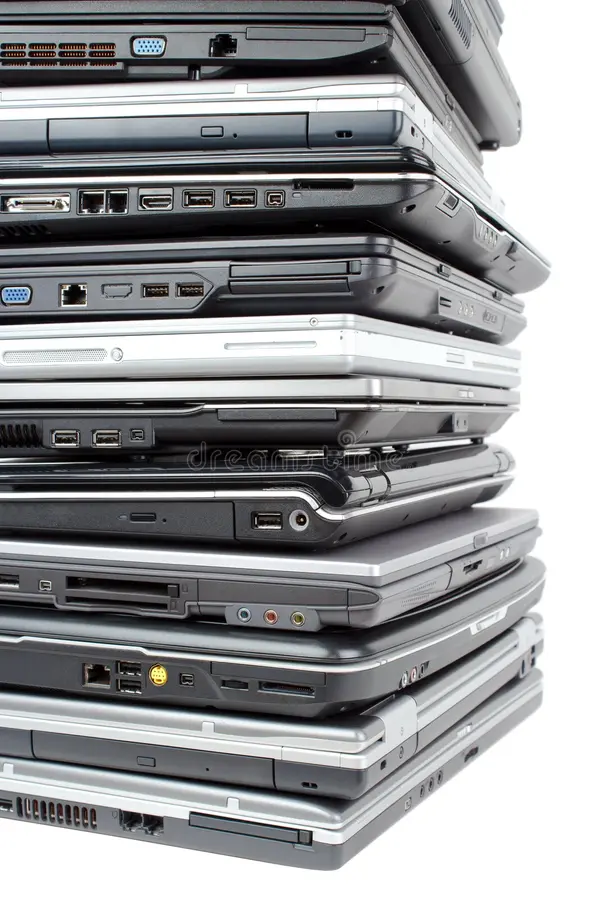
What happens to a laptop when it is no longer used?
Sometimes it stays in a drawer. Sometimes it is passed from hand to hand. Sometimes, it simply disappears. But there is something that never disappears on its own: the data it contains.
And in a world where information is one of a company's most valuable assets, leaving a hard drive unerased is like leaving the keys to your office lying on the street.
Why hardware destruction is not just throwing away equipment
Most companies have a more or less clear process for buying equipment, delivering it, and —with luck— recovering it when someone leaves.
But few think about what to do with those devices once they are no longer in use.
And the problem is not the hardware: it is the data that remains inside. Even if you format a drive, the information can still be there. And anyone with basic tools can recover it. That is to say:
Internal documents
Saved accesses
Customer information
Passwords, cards, and contracts
The risks of not properly destroying equipment
It is not about paranoia. It is about protecting yourself from real-world scenarios:
Sensitive data leaks
A poorly managed device can end up in the wrong hands. The result? From fines to legal and reputational problems.
Regulatory non-compliance (Data Protection Act)
Many regulations (such as GDPR or its equivalent in LATAM) require guaranteeing the secure erasure of information.Uncontrolled resale
Are you sure that the used equipment you sold has no traces of information?Exposure of internal accesses
A browser with saved passwords can open the door to your entire system.
What "secure destruction" really means
We are talking about certified processes that guarantee that no data can be recovered, even by experts.
The most commonly used methods are:
Secure erasure (certified data wipe)
Removes all information from the device using specific tools.
Ideal for equipment that is later refurbished or donated.
At First Plug we use software approved by international standards (such as NIST 800-88).
Physical destruction of disks
Hard drives are shredded or punctured.
This is done when the equipment is not going to be reused and security is a priority.
Destruction certificates
They document the entire process, including serial number, date, applied method, and signature of the person in charge.

Cases where secure destruction is key
Employee offboarding
A returned laptop is not always checked as it should be. A recovery process without secure destruction is leaving the door ajar.
Device replacement in large companies
When you upgrade dozens or hundreds of notebooks, you cannot rely on manual formatting.
Companies with sensitive data
Law firms, fintechs, marketing agencies, human resources, healthcare. If you work with confidential information, there is no room for error.
Companies selling used equipment
It is not enough to refurbish a device. It is necessary to guarantee that what is sold is clean inside and out.
What should an ideal destruction process look like?
Equipment recovery
Logistics are coordinated to bring the equipment from wherever the employee is located.Inventory and traceability
Serial number, condition, and equipment destination are recorded.Destination evaluation
If refurbished → secure wipe.
If decommissioned → physical destruction.Application of the correct method
Depending on the case, a wipe or destruction is carried out.
Why outsource this process?
Because doing it right requires time, tools, knowledge, and responsibility.
At First Plug we offer:
Reverse logistics to recover the equipment
Wipe or secure destruction depending on the case
Certificates with full traceability
Integration with your management platform
Support in multiple countries
We help you comply with regulations, protect data, and decommission your equipment securely.
In summary
Throwing away equipment is not just getting rid of a burden. It is closing a stage responsibly. And in that closure, what you do with the data makes the difference between having peace of mind or being at risk.
Destroying is not losing. It is protecting.
And protecting is also growing.
You might also be interested in…