
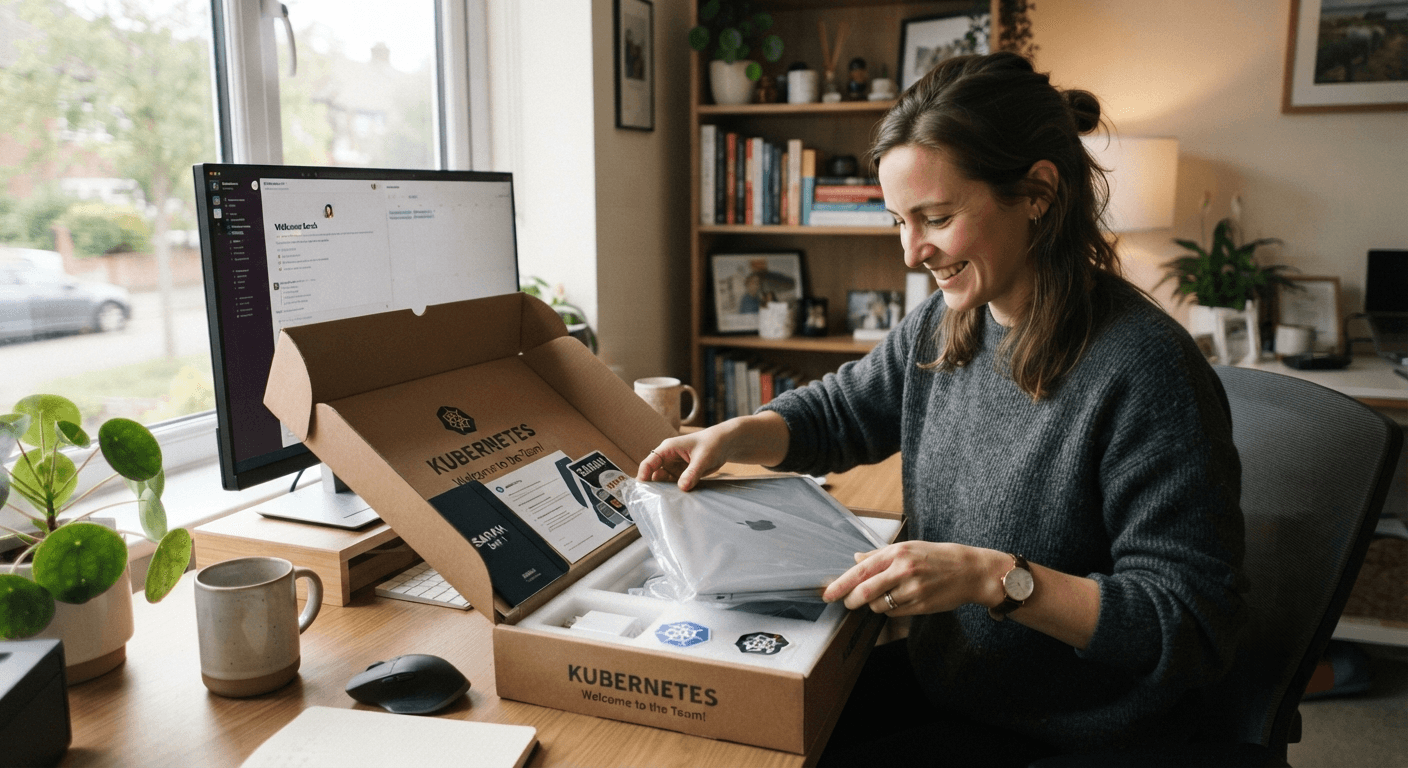
How long a remote employee's hardware onboarding takes depends on one single thing: whether there is a defined process or not.
Without a process, each new hire becomes an isolated project - searching for a supplier, requesting quotes, waiting, coordinating delivery - and that translates into weeks. With an orderly process and the right operation behind it, it is reduced to days.
Why remote hardware onboarding usually fails
When there is no centralized process, each country or each manager figures it out on their own. They buy from local retail, request quotes from whoever is at hand, or wait for someone from IT to have time.
The result of this improvisation is always the same: uncontrolled purchases, equipment taking longer than expected, and no clear record of what was bought, for whom, or under what conditions.
Added to that is operational blindness. When there is no traceability from day one, you won't get it six months later either, when an employee leaves and no one knows where the equipment ended up.
Hardware onboarding doesn't fail due to a lack of budget or a specific logistical issue. It fails because it is not designed as a process.
Who does what in the process
Before the step-by-step, it is useful to clarify the roles. One of the most common frictions is not knowing who is responsible for what.
Stage | Done by company HR/IT | Done by First Plug |
|---|---|---|
Onboarding entry | Yes (name, country, address, equipment) | - |
Quotation | Approves | Generates the number with equipment + logistics |
Equipment purchase | - | Yes |
Shipping and customs management | - | Yes |
Delivery to employee | - | Yes |
Asset platform registration | Consults | Uploads and keeps updated |
In summary: The client decides what they need and approves. First Plug executes everything else.

The step-by-step at First Plug
1. The order
Everything starts on the platform. The new hire is loaded: name, country, address, and the equipment model they need.
No looking for a local vendor, comparing prices, or opening a quote outside the system. A single point of entry, regardless of the destination country.
2. The quote
We return the quote with the equipment and logistics included in a single number. No hidden costs appearing later or surprises when the invoice arrives.
3. Approval and purchase
With the client's approval, we purchase the equipment and activate logistics through our own operation in the destination country, if it is in LATAM.
There is no outsourcing involved. In every country where we operate, we have a direct presence, with our own team that knows the terrain: import regulations, actual lead times, and regional particularities.
This is what makes it possible to maintain deadlines even in countries where buying corporate hardware is usually slow. If it is outside LATAM, we also take care of the shipping: we reach +170 countries.
4. Configuration
Before the device is dispatched, the necessary software is adjusted: operating system, MDM, accesses, and the core tools that the employee will need from day one.
This removes a task from IT's shoulders that, if poorly resolved, ends up generating support tickets during the new hire's first week.
5. Delivery
The equipment arrives at the employee's home, ready to use. Neither the new hire nor the HR team has to handle customs, local transportation, installation, or adjustments.
6. Registration
The equipment is registered in the asset platform: what equipment it is, who has it, in which country it is located, and what its status is.
This is what makes frictionless offboarding possible later. The asset is already tracked from day one.

With process vs. without process: what changes
Without process | With First Plug | |
|---|---|---|
Delivery time | Weeks, variable due to manual management | Days, with a defined deadline from the quote |
Equipment visibility | None or in spreadsheets | Centralized in asset platform |
Purchases | Individual, without price control | Single, with prior quote |
Recovery in offboarding | Uncertain | Tracked from day one |
Local regulatory knowledge | Responsibility of the client | Responsibility of First Plug |
Checklist: Is your hardware onboarding process working?
Can you find out in less than a minute what equipment each remote collaborator has?
Does hardware purchasing go through a single process, or does each manager handle it on their own?
Do you have a defined delivery window before approving the purchase, or is it "whenever it arrives"?
Do you know what happens to the equipment on the day that collaborator leaves?
Does anyone on your team know the specific import regulations of each country where you have remote staff?
If you answered no to two or more, the problem probably isn't the specific logistics of your last shipment. It's that there is no process.
Conclusion
Equipping a remote employee is not a logistics problem. It is a process problem.
When every country, every purchase, and every adjustment depends on manual and isolated management, time is lost between steps: finding a supplier, waiting for approval, coordinating shipping, and later reconstructing what was bought and for whom.
A centralized process solves that at its root. Not because it speeds up each individual task, but because it eliminates operational blindness. Companies without a process only discover the problems with their technology fleet when they are already major.
First Plug's own operation in LATAM is what maintains delivery times even in complex regulatory contexts. And traceability from order to registration turns onboarding into the starting point of a well-managed hardware life cycle.
Frequently asked questions
How long does it take for the equipment to reach a remote employee?
It depends on the country and the chosen model. With an orderly process, the timeframes are days, not weeks. The exact time is defined in the quote, before approving the purchase.
What happens if my employee is in a country where First Plug has no direct presence?
First Plug has its own operations in LATAM and also ships to more than 170 countries worldwide.
Do I need a legal entity in the employee's country to equip them?
No. The client does not need a local legal entity to equip collaborators in other countries.
You might also be interested in…