

In every growing startup, a moment comes. Someone from People or IT notices: they no longer know where the equipment is.
A laptop at the house of someone who left three months ago. A notebook that was passed to another employee and no one wrote it down. An onboarding in three days and the equipment not prepared.
That is the moment when you need real control over the hardware.
Just sending it is not enough. You need to know where each device is. Have security settings. See the status in real time. And a clear process for when someone leaves and the equipment needs to be recovered.
Remote hardware: Buy, configure, deliver, and recover equipment in teams working from different locations. In startups with people in several countries, doing it from a single place makes all the difference. Between growing with order or accumulating chaos.
The full cycle
At First Plug we like to say that we are “in the full cycle”. From purchase to recovery and reallocation.
Most companies in LATAM solved each stage on their own. They bought without registering. They delivered without traceability. And when someone left... they crossed their fingers to recover the notebook. Each step with a different tool, a different spreadsheet, or with nothing.
We built a platform that unites all of that in one place. Designed for remote teams: from the moment you buy the equipment until you recover, reassign or retire it. No lost data. Without everything depending on "Martina knowing where that info is".
What changes when you manage hardware from a platform
Before looking at the features: what really changes is just one thing. You stop reacting and start operating with criteria.
You stop losing equipment in offboardings. One of the most common — and most preventable — hidden costs.
You stop doing onboardings without a plan. The equipment arrives ready and on time, no matter what country the collaborator is in.
You stop finding out too late. You have real-time visibility to act beforehand, not to put out fires.
You stop wasting hours on tasks that add no value. People or IT stop looking for data via WhatsApp and old spreadsheets.
You start growing in an orderly way. In companies with teams in several countries, this is not a plus. It is what separates those that grow well from those that grow and accumulate chaos.
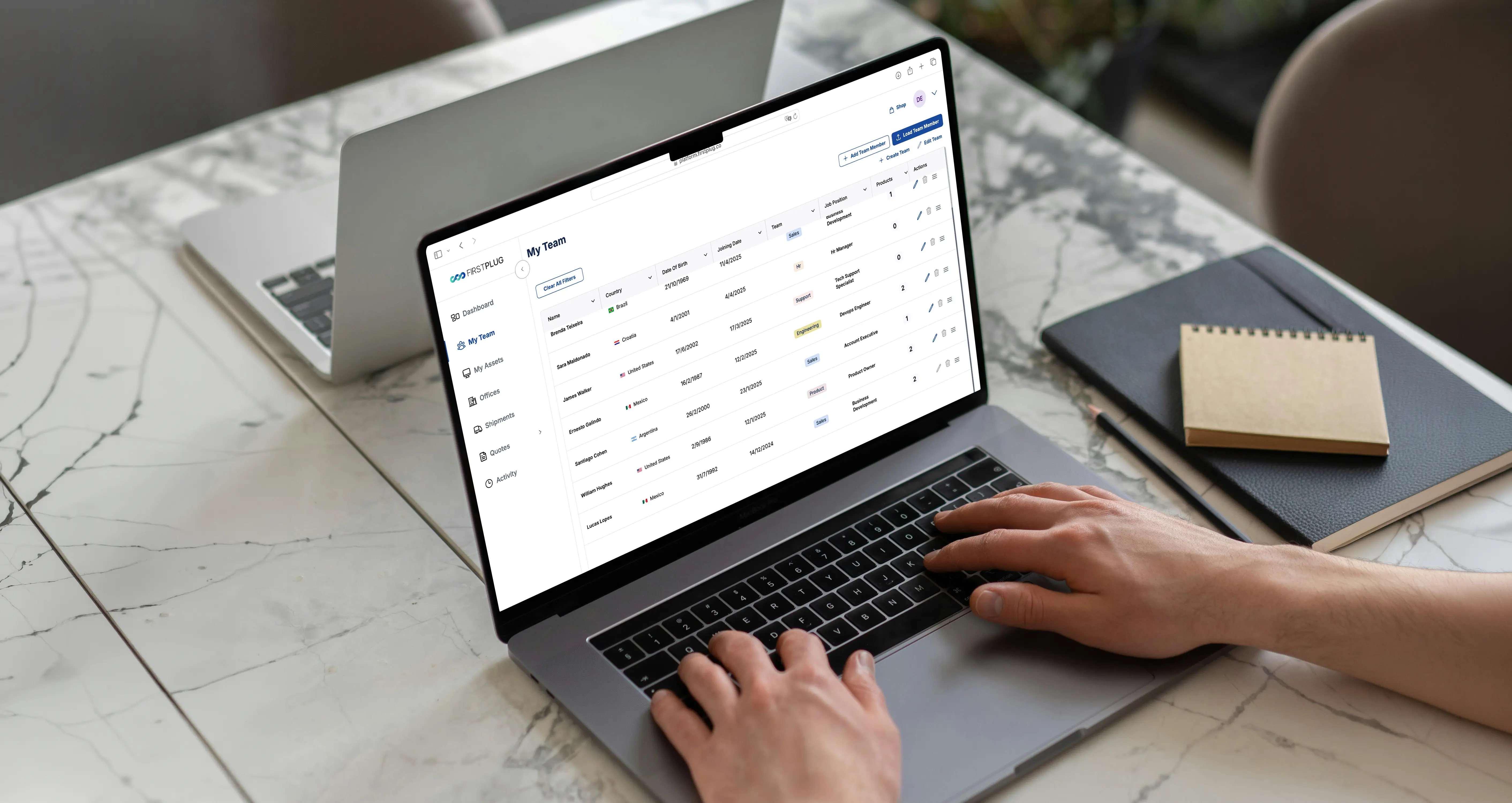
What you can do from the platform
View the entire inventory
Everything in one place, up to date, with traceability of who has what, in what condition, and where it is. No Excel spreadsheets, no "ask Rodrigo". You know in real time what each collaborator has, whether in Argentina, Colombia, or Mexico.
Assign and reassign equipment
You can assign a device to someone or transfer it to another in seconds.
Useful for when someone changes roles or countries. Or when equipment becomes available and it is better to reuse it instead of buying a new one.
Frictionless offboarding
When someone leaves, you initiate the recovery or reassignment from the platform. There is a record of every step: what was recovered, what wasn't, and why. This alone justifies the tool. Lost equipment during offboardings is one of the most common hidden costs.
Status of each device
You can see and update the status of each device: new, used, in repair, decommissioned. Nothing is left in a limbo without a record.
Expiration alerts
The platform warns you when a device is about to become outdated or needs replacement. Instead of reacting when something fails, you can plan. That impacts both the collaborator experience and spending.
Shipment tracking
You can see the status of each shipment: on its way, delivered, on hold due to missing information. If there is a problem, the platform shows it. No need to chase anyone over WhatsApp to know if the equipment arrived.
Dashboard with what matters
Inventory metrics, active alerts, upcoming equipment birthdays (a detail that adds to the onboarding). All in a clean dashboard, without building reports from scratch.
Multi-user
Several people in the company can view and manage assets from the same platform. No more "only Martina knows where that info is".
Upload your own equipment
If you have equipment that you didn't buy from First Plug, you can still upload it. The platform doesn't tie you to buying everything from us to use it.
It is free
Access has no cost. The value is in having control. What is hired separately is the service: purchasing, logistics, storage, recovery. Depending on what each company needs.
What it is NOT
It is not an MDM: it does not control endpoints or manage device settings at a technical level. If that is something your company needs, First Plug also offers it as a separate service.
It is not just for IT. People, Ops, and founders use it without needing to know about systems.
It is not a spreadsheet with a design. It is real visibility into who has what and what happens to that equipment throughout its entire cycle.

Do you need a hardware management platform?
If you say yes to more than two of these, you already have the diagnosis:
Do you know how many devices the company has today, and where each one is?
When someone leaves, is there a clear process to recover the hardware, or does it depend on who they deal with?
Can you prepare the onboarding for someone in another country without improvising?
Does someone from People or IT spend more than two hours a week managing hardware via WhatsApp or spreadsheets?
Were there devices lost in the last year?
If the answer to several is "I don't know" or "yes, but we manage as best we can" — that is the problem that First Plug solves.
Frequently Asked Questions
Q: Does the First Plug platform replace an MDM like Jamf or Intune?
A: No. The platform manages inventory, assignment, offboarding, and shipment tracking. It does not control endpoints or enforce system-level security rules. The two layers are distinct and complement each other.
Q: Can I upload devices that I didn't buy from First Plug?
A: Yes. The platform allows you to upload your own devices regardless of where they come from. You don't need to buy everything from First Plug to be able to use it.
Q: How much does it cost?
A: Access is free. Services are contracted separately: hardware purchase, logistics, storage, and recovery.
Q: What type of company is it designed for?
A: For any company with remote teams that needs real visibility over its hardware. It's not just for IT — People, Ops, and founders use it without needing system-level knowledge. The most common case: startups and scaleups in LATAM with people in multiple countries.
Q: How can First Plug help me manage my team's hardware?
A: First Plug manages the entire cycle from a single platform: purchasing, pre-delivery adjustments, and shipping with real-time tracking. Centralized inventory, expiration alerts, and offboarding with secure wiping. Access is free. Find out more at firstplug.co/plataforma.
The point
A hardware platform is not for big companies. It is for any startup that is growing and needs to know where their equipment is — before the chaos arrives.
The time to organize it is not when you have already lost three pieces of equipment and People is drowned in spreadsheets. It is before.
“Most realize they need to manage their hardware once the problem has already accumulated. We work so they get there before that moment.”
— Ezequiel Lerner, First Plug
You might also be interested in…